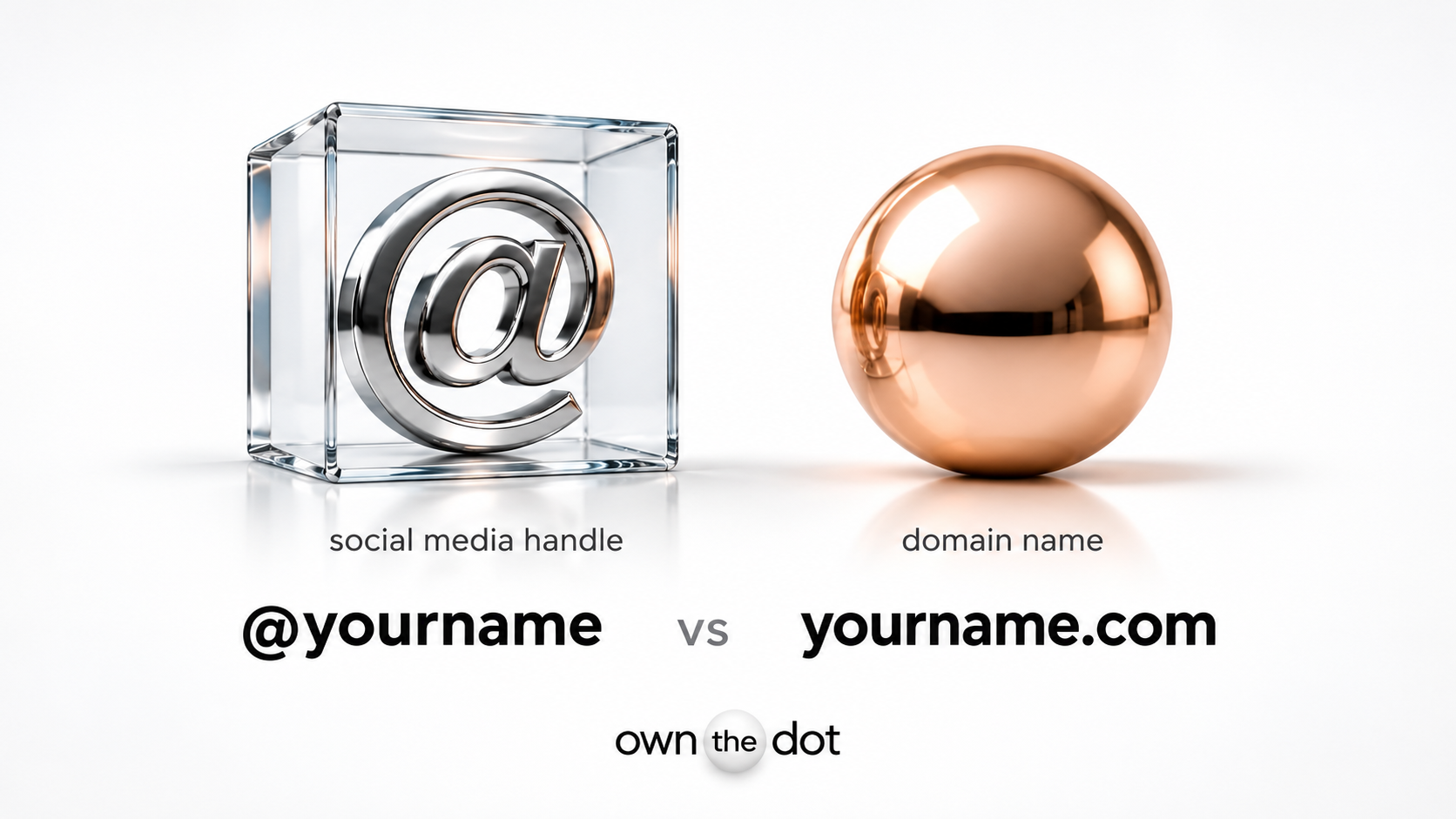
Domain names, social media handles, and who really controls your online identity.
What's in a Name?
Most of us have at least one social media handle.
It might be @OwnTheDot on X, Instagram or TikTok. If you run a business, you probably have a domain name as well, something like yourbusiness.com.
Both help people find you online. Both can become valuable, and both can represent a reputation you've spent years building.
But there's an important difference between them.
A social media handle belongs to a naming system controlled by the platform you use. A domain name is registered within the internet's Domain Name System, where you generally have greater freedom to transfer it, change providers and decide how it's used.
Most people probably don't give that distinction much thought.
Until someone else wants their name.
The Story of Two Xs
In 2017, Elon Musk purchased X.com from PayPal.
Musk had originally co-founded X.com in 1999 as an online financial services business. The company eventually became part of what developed into PayPal.
Years later, Musk wanted the domain back.
PayPal controlled the registration, so the two parties negotiated a sale. The amount Musk paid was never publicly disclosed.
Six years later, Musk wanted another X.
This time, it was the username @X on Twitter.
Photographer Gene X Hwang had registered the handle in March 2007. Over the following 16 years, he'd built an audience of approximately 53,000 followers and reportedly turned down offers of up to US$40,000 for the username.
When Twitter became X in July 2023, the company wanted that username for its new identity.
Rather than negotiating a purchase, it reassigned Hwang's handle to its official account.
Hwang received a replacement username and kept his followers and account history. He wasn't paid for @X, although the company offered him merchandise and a visit to its headquarters.
He appeared to take the situation reasonably well, even joking about getting the old Twitter bird sign from the building.
The contrast is hard to miss.
When Musk wanted X.com, he purchased it. When his company wanted @X, it reassigned it.
The same letter, but two very different outcomes.
And the reason comes down to who controls the naming system.
Is Your Social Media Handle Really Yours?
When you create an account on a social media platform, you're allowed to choose a username from those available.
That name becomes your identity within the service. Friends recognise it, customers search for it, and followers associate it with you.
Over time, it can become surprisingly valuable.
A business might spend thousands promoting a username. A creator might build an audience of hundreds of thousands of people around one handle.
Yet that doesn't necessarily give either of them an independent right to keep it.
The platform sets the rules.
It decides which usernames are available, whether they can be transferred, and what happens when accounts are suspended, removed or become inactive.
Even years of use don't necessarily change that arrangement.
And if you decide to leave the platform, your username doesn't automatically come with you.
You can't simply transfer @yourbusiness from Instagram to X in the way you might transfer a domain registration between registrars.
You'd have to register the username again, assuming it's available.
Your followers don't automatically move either.
You might have built the audience, but the platform still controls much of the relationship between you and those followers.
Why Domain Names Are Different
Now consider a domain name.
Let's say you register yourbusiness.com.
You can use it for your website, create email addresses such as hello@yourbusiness.com and connect it to other internet services.
If you're unhappy with your website hosting company, you can move your website elsewhere without changing your domain.
If you change email providers, you can keep the same email address.
And if you decide to sell your business, you can generally transfer the domain registration to its new owner, subject to the relevant rules.
That's something a social media handle doesn't necessarily allow.
A domain name can remain part of your identity while the companies providing services behind it change.
It isn't tied to one social media platform or website hosting provider.
That doesn't mean domain names operate without restrictions. Registrations need renewing, and registrants must comply with registry policies, contractual obligations and applicable laws.
But the rights attached to a conventional domain registration are generally more portable than those attached to a social media username.
And that portability can make a considerable difference over time.
Do We Actually Own Our Domain Names?
We often describe ourselves as owning domain names.
I have a few myself.
Technically speaking, registering a conventional domain gives you contractual rights to use that name for a defined period, provided you comply with the applicable rules.
Those rights can usually be renewed, transferred or sold.
Registering yourbusiness.com doesn't mean you own the .com extension. You're registering a name beneath it.
The registry operates the extension, while registrars provide the registration services.
Disputes can still arise, particularly where trademarks or other legal rights are involved.
So although people commonly refer to domain ownership, conventional registrations aren't quite the same as owning a physical piece of property.
Still, there's a meaningful difference between holding transferable registration rights and receiving permission to use a username within a company's platform.
And that difference becomes even clearer when money enters the picture.
Paying for a Name You Don't Own
In October 2025, X introduced its Handle Marketplace.
The service allows eligible users to request certain inactive usernames, with some premium handles carrying substantial transfer prices.
According to X's published rules, premium usernames can potentially reach seven figures in US dollars.
That's more than a million dollars for the right to use a name on a social media platform.
X's terms are quite clear.
The company retains ownership of the handles and grants users a limited, revocable and non transferable licence.
The conditions differ depending on how a handle is obtained, but paying for one doesn't automatically give the user independent ownership rights.
Compare that with buying an existing .com domain.
When someone purchases a domain registration, they can generally acquire rights that allow them to transfer or sell that registration again.
With a social media handle, the platform decides what transfers are permitted.
Both names might command considerable sums of money.
But the buyer isn't necessarily acquiring the same kind of rights.
And the amount paid doesn't change that fundamental distinction.
What Happens If Your Account Disappears?
Imagine you've spent ten years building a business around a social media account.
Your handle appears on your advertising, business cards, vehicles and packaging.
Customers recognise it immediately.
Then one day, the account becomes inaccessible.
Perhaps it's been compromised. Perhaps the platform suspends it, or changes a policy that affects your account.
You might eventually recover access, but in the meantime, how do customers find you?
If your entire online identity depends on that one account, you could lose your main means of communicating with the people you've spent years attracting.
A domain name gives you another option.
Customers can still visit your website, send an email or find your contact details without needing access to the same social media platform.
Your domain won't prevent every possible technical or legal problem, but it means your online presence doesn't have to depend entirely on a single social media account.
And there's nothing stopping you from using both.
Your social media accounts can help people discover you, while your domain provides a consistent place where they can find you regardless of which platform they prefer.
That's a much more flexible arrangement than depending on an @ symbol alone.
The Next Step in Naming
Domain names give us considerably more independence than social media handles, but we're still registering names beneath extensions operated by someone else.
Handshake takes that idea a step further.
Rather than registering a name beneath an existing extension such as .com, Handshake allows people to acquire and control top level names through a decentralised protocol.
That control is exercised using cryptographic keys and maintained according to the protocol's rules, rather than depending on a single company to administer the entire naming system.
There are still responsibilities. Names need renewing, keys need protecting, and trademark laws don't simply disappear. Handshake names also require compatible technology to resolve them.
But it's an interesting evolution in internet naming.
Social media platforms allow us to use names within their services. Conventional domain registrations give us addresses that can move between providers. Handshake offers another way to control the top level name itself.
It's not absolute ownership, but it moves more of the control towards the individual.
Before You Build Your Name
There's nothing wrong with using social media.
I use it myself, these platforms provide opportunities to communicate and reach audiences that would otherwise be difficult to find.
I wouldn't want my entire online identity to depend on a username controlled by a single company.
The story of X.com and @X shows why.
Elon Musk negotiated the purchase of an existing domain registration. Years later, the company he owned reassigned a longstanding social media handle under its own platform rules.
⚪️Both names had value.
Both had histories.
Yet the people using them had very different rights.
A social media handle gives you an identity within a platform. A domain name gives you a more independent address that can continue with you as your online services change.
And newer naming protocols are exploring what greater individual control might look like.
None of these systems guarantees permanent ownership without responsibilities or restrictions.
But they do offer different levels of control.
If you're going to spend years building a reputation around a name, it's worth understanding whether you can take that name with you, or whether someone else ultimately gets to decide.
Own the Name | Own the Rules | Own The Dot.