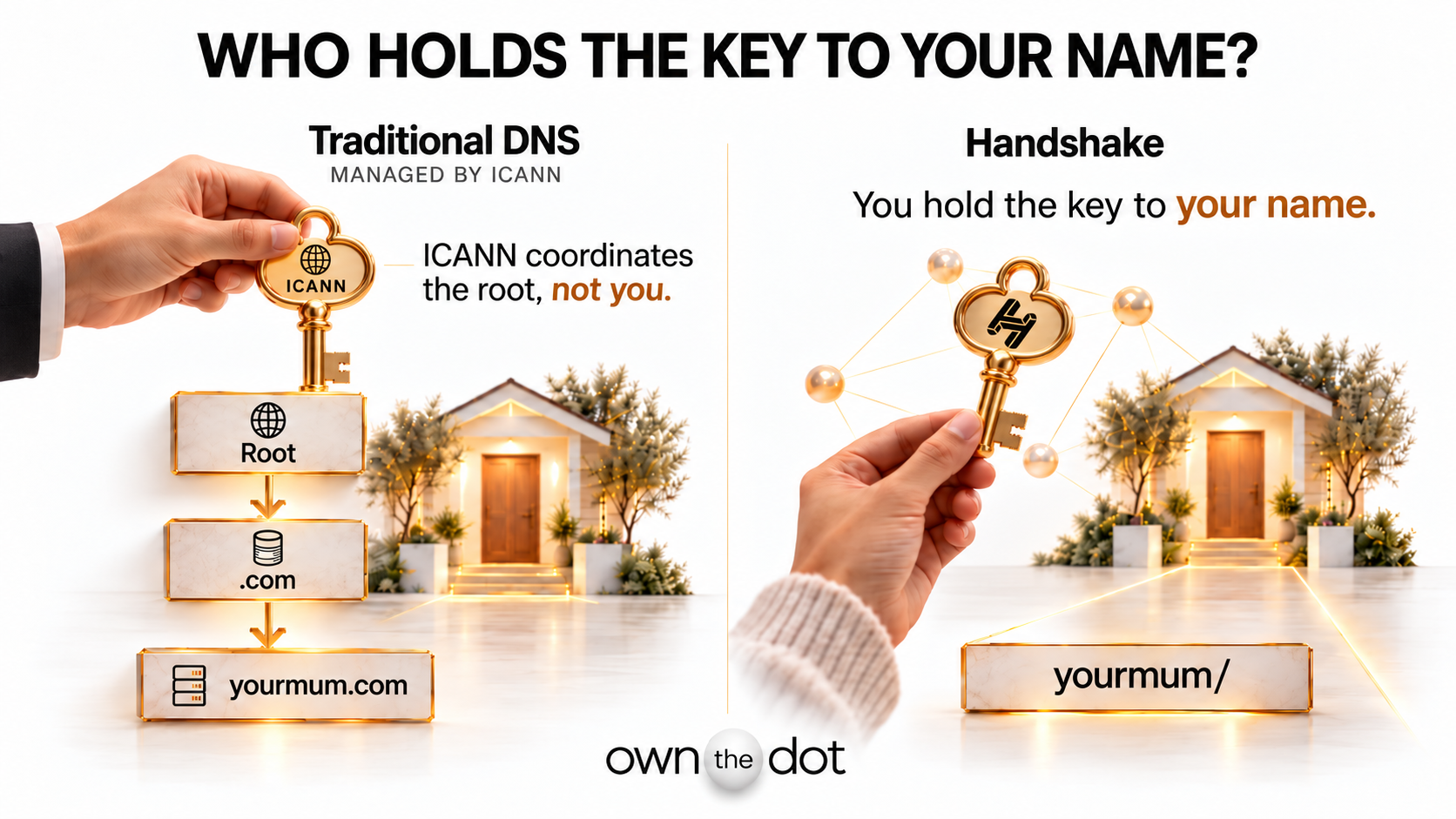
We all like to visit a place we call home. Somewhere familiar, where we feel safe, where we trust the people around us.
The internet isn't so different.
Every day, we navigate somewhere online. Whether it's for work, shopping, booking a holiday or simply visiting someone we know and trust.
Who better to trust than our mum?
Let's use her in this example.
Imagine your mum has two internet addresses:
⚪️ yourmum.com using the traditional DNS.
⚪️ yourmum/ using Handshake.
Both could take us to the same place.
But how do we know we're really visiting our mum and not someone pretending to be her?
That's where the question of who we trust to get us there becomes important.
Visiting Mum Through the Traditional DNS
When you visit yourmum.com, your device relies on the traditional Domain Name System (DNS) to find the correct destination.
Think of it like asking for directions.
Your device uses a system of names and addresses that ultimately traces back to the DNS root, coordinated through ICANN and supported by established internet infrastructure.
For names protected by DNSSEC, a chain of digital signatures lets a validating resolver check that the DNS information has not been altered. The chain begins with the DNS root's trust anchor and continues through .com to your mum's domain, provided the relevant zones are signed.
It's a bit like asking someone you trust for directions, who points you to someone else they trust, until you reach your mum's front door.
You're relying on a recognised chain of trust to help confirm the directions are genuine.
DNSSEC helps confirm that the directions to your mum's website are genuine. But it can't tell you whether it's actually your mum waiting at the other end.
Visiting Mum Through Handshake
Now imagine visiting yourmum/.
This time, your device uses Handshake, a decentralised naming protocol that operates independently of the traditional DNS root.
Instead of relying on ICANN's root zone hierarchy, Handshake uses a blockchain maintained by a distributed network of participants.
The blockchain records control of the name and the naming information associated with it. If your mum holds the cryptographic keys for yourmum/, she can manage the name's records herself, subject to the protocol's rules.
A properly configured Handshake resolver can verify that naming information against the blockchain.
It's another way of checking the directions to your mum's house, without depending on the traditional DNS root to establish where that name leads.
The trust comes from the network's shared rules, cryptographic verification and control of the name's keys.
Just as with DNSSEC, verifying the naming information doesn't automatically prove the person behind the website is your mum.
Two Ways of Establishing Trust
Both systems can help us reach a website, but they start from different foundations.
| Traditional DNS | Handshake |
|---|---|
| Uses the ICANN coordinated DNS root | Uses a decentralised blockchain naming root |
| DNSSEC can verify records through a hierarchical chain of trust | Handshake verifies naming information through blockchain consensus |
| Domain names are registered through registries and registrars | Top level names can be managed by whoever controls their cryptographic keys |
| Works through conventional DNS infrastructure | Requires compatible resolution software or services |
Neither system eliminates every security risk. A verified name doesn't automatically mean a website is safe or trustworthy.
Does It Matter Which Way We Visit Mum?
If both addresses take us to the same website, does it really matter how we get there?
For many people, perhaps not. Most of us type an address into a browser and expect it to work.
But behind that action lies a question:
Who ultimately controls the naming system we rely upon?
With traditional DNS, ICANN coordinates the root, while registries, registrars and domain holders each have different responsibilities and forms of control. ICANN does not hold every website owner's private key.
With handshake, an individual can directly control a top level name using their own cryptographic keys, rather than receiving that top level name through ICANN's application and delegation process.
The distinction isn't that one system can always be trusted and the other cannot. It's about where authority sits, and who gets to exercise it.
A Choice Worth Understanding
My Personal View
Personally, I’d rather hold the keys to my own internet name.
Rules can change, policies can change, and decisions can be made that are beyond my control.
If that ever happens, I’d like the peace of mind knowing that my name is still mine to manage, without having to seek someone else’s permission.
That’s what appeals to me about Handshake. As long as I protect my keys and meet the protocol’s requirements, I can remain in control of my name.
For me, it’s not about replacing the traditional DNS.
It’s about having a choice, and knowing who ultimately holds the key.
Own The Name | Own The Rules | Own The Dot.