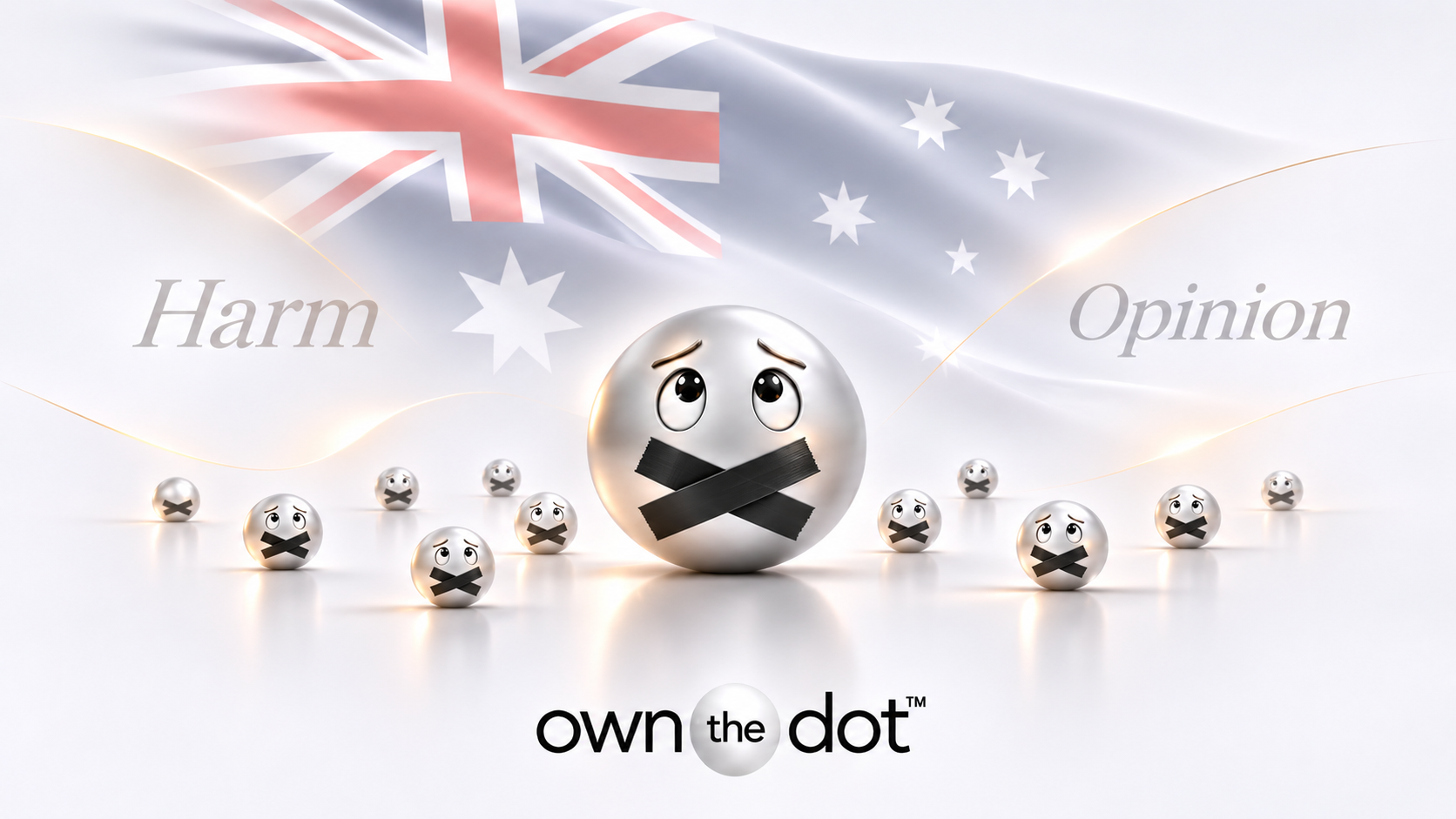
On Wednesday, 25 November 2026, Australia's Parliament passed its Digital Duty of Care legislation, introducing significant changes to how online services are expected to protect their users. The government's announcement confirms parliamentary passage and says the duty will come into effect in 12 months. Passage does not mean the new obligations are already in force.
The legislation aims to make technology companies more accountable for preventing serious online harm, rather than simply responding after it occurs.
A reasonable ambition. Children deserve protection, online exploitation should be addressed, and individuals should have meaningful avenues to seek redress when things go wrong.
But while the intentions may be good, I remain concerned about something far more difficult to define.
What actually constitutes harm, Who ultimately gets to decide?
When Interpretation Becomes the Harm
In my earlier article, Digital Duty of Carelessness?, I questioned how harm would be interpreted and how much discretion those responsible for implementing and enforcing the legislation might exercise.
Now that Parliament has passed the bill, those questions have become even more important.
In an update published on 26 November 2026, the Law Council of Australia summarised its 18 November submission. While broadly supportive of the proposed duty, it called for clearer definitions of serious harm and greater certainty about exclusions for public interest material. These concerns were raised before the final amendments were passed; whether the final legislation fully addresses them deserves continued scrutiny.
There are forms of harm that most people can readily recognise. Exploitation, credible threats and targeted harassment are serious matters that deserve attention.
But not every uncomfortable conversation is harmful. Not every controversial opinion is hateful. And not every criticism of a government, institution or individual should be treated as a threat.
One person's deeply held belief may be another person's source of offence.
Who draws that line?
When Vague Interpretations Create More Harm
What disappoints me most about Australia's Digital Duty of Care legislation is the uncertainty surrounding how harmful content may be interpreted.
The law is intended to prevent harm, yet broad regulatory standards leave room for different interpretations of what constitutes unacceptable online behaviour.
What I find particularly fascinating is that legislation designed to prevent harm can pass through Parliament despite concerns about the clarity of what constitutes harm.
Surely, establishing a clear understanding of harm should be fundamental to any legislation intended to prevent it.
A responsible government, elected to represent and protect the interests of the Australian people, has an obligation to ensure that its legislation is clear, proportionate and capable of being applied consistently.
In my view, by allowing this uncertainty to remain, the government has not served the Australian people well. Instead, it risks creating further uncertainty for the very people it seeks to protect.
If Parliament cannot establish sufficiently clear boundaries, how can Australians be expected to know where those boundaries lie?
Should clearly defining harm not come before regulating it?
One person's criticism may be another person's offence. A strongly expressed concern about government policy might make others uncomfortable, but discomfort alone should not be enough to silence legitimate discussion.
If online platforms respond to regulatory uncertainty by restricting lawful expression, the result may be frustration rather than greater public confidence.
People may find themselves unable to voice genuine concerns, challenge decisions or participate openly in discussions that affect their lives.
Worse still, they may never fully understand why their words were considered unacceptable in the first place.
A law intended to prevent harm should not create another form of harm through inconsistent interpretation and unnecessary restrictions on lawful expression.
That is my disappointment.
Australia may be leading the world in online safety legislation, but leadership means little if ordinary people become increasingly uncertain about what they are permitted to say.
Protecting people from genuine harm is important. So is protecting their right to be heard.
If the interpretation of harm becomes so broad that lawful voices are discouraged or silenced, are we genuinely creating a safer internet, or simply a more controlled one?
Who Holds the Decision Makers Accountable?
Australia's new framework is intended to strengthen the accountability of online services.
But accountability should operate in both directions.
If content is restricted, users should understand why. If a decision is disputed, there should be a meaningful way to challenge it. And if an interpretation proves unreasonable, there should be a clear process for correcting that decision.
Parliamentary oversight, independent review, transparency and proportionality are not obstacles to online safety. They are essential safeguards against the misuse of regulatory authority.
Governments change. Social attitudes change. What is considered acceptable today may be viewed differently tomorrow.
A law should be judged not only by how the current government intends to use it, but also by how its powers could be exercised by future governments.
Leading the World Requires Greater Scrutiny
Australia has positioned itself as a world leader in online safety regulation.
That ambition deserves scrutiny rather than automatic celebration.
When a country introduces substantial new regulatory powers, other governments may examine its approach and consider similar measures.
Whether they ultimately follow Australia's example remains to be seen.
But if Australia wants to establish an international benchmark, shouldn't that benchmark include strong protections for lawful expression, privacy, individual rights and independent oversight?
Leadership should not simply be measured by how much regulatory authority a government establishes.
It should also be measured by how carefully that authority is limited.
Your Name. Your Voice.
This is where independent internet naming becomes relevant.
Handshake Australia's mission is to create awareness of the Handshake naming protocol and its ability to give people greater independence over their digital names.
Handshake provides an alternative naming system in which individuals can control independently verifiable top-level names without relying on a conventional central registry.
The purpose is straightforward: to help people maintain an independent digital identity through which they can establish a presence online and voice their concerns.
That does not make its owner immune from legislation, content restrictions or access blocking. Hosting providers can remove websites, resolvers can restrict access, names can expire, and compromised private keys can result in lost ownership.
But at least you retain a name through which your voice can be heard, provided others have a means of reaching it.
An independently controlled name does not guarantee an audience. It does, however, offer continuity of identity beyond the control of any single social media platform or conventional registry.
And that distinction matters.
A Safer Internet Should Still Be a Free Internet
I support the principle of protecting people from genuine online harm.
But I also believe we should be cautious whenever legislation creates uncertainty about what may be considered harmful, who interprets those standards and how those decisions can be challenged.
A safer internet should not come at the expense of legitimate disagreement, independent thought or the freedom to question those in authority.
Perhaps the most important question arising from Australia's Digital Duty of Care is not whether the legislation will prevent harm.
It is whether we have done enough to prevent harm arising from the way it is interpreted.
⚪️ Because if protecting people from harm also means deciding which lawful voices deserve to be heard, who protects us from ‘that’ decision?
⚪️ Do you find this article harmful? If it is, who decides whether others are allowed to read it?
Author's Note
The opinions expressed in this article are my personal views as the author of Own The Dot. They do not represent an official position of Handshake Australia (hns.au).
Handshake Australia's purpose is to promote awareness and understanding of the Handshake naming protocol and the opportunities it provides for independent digital naming.
Erwin Groen
Own The Dot™
Own the Name | Own the Rules | Own The Dot