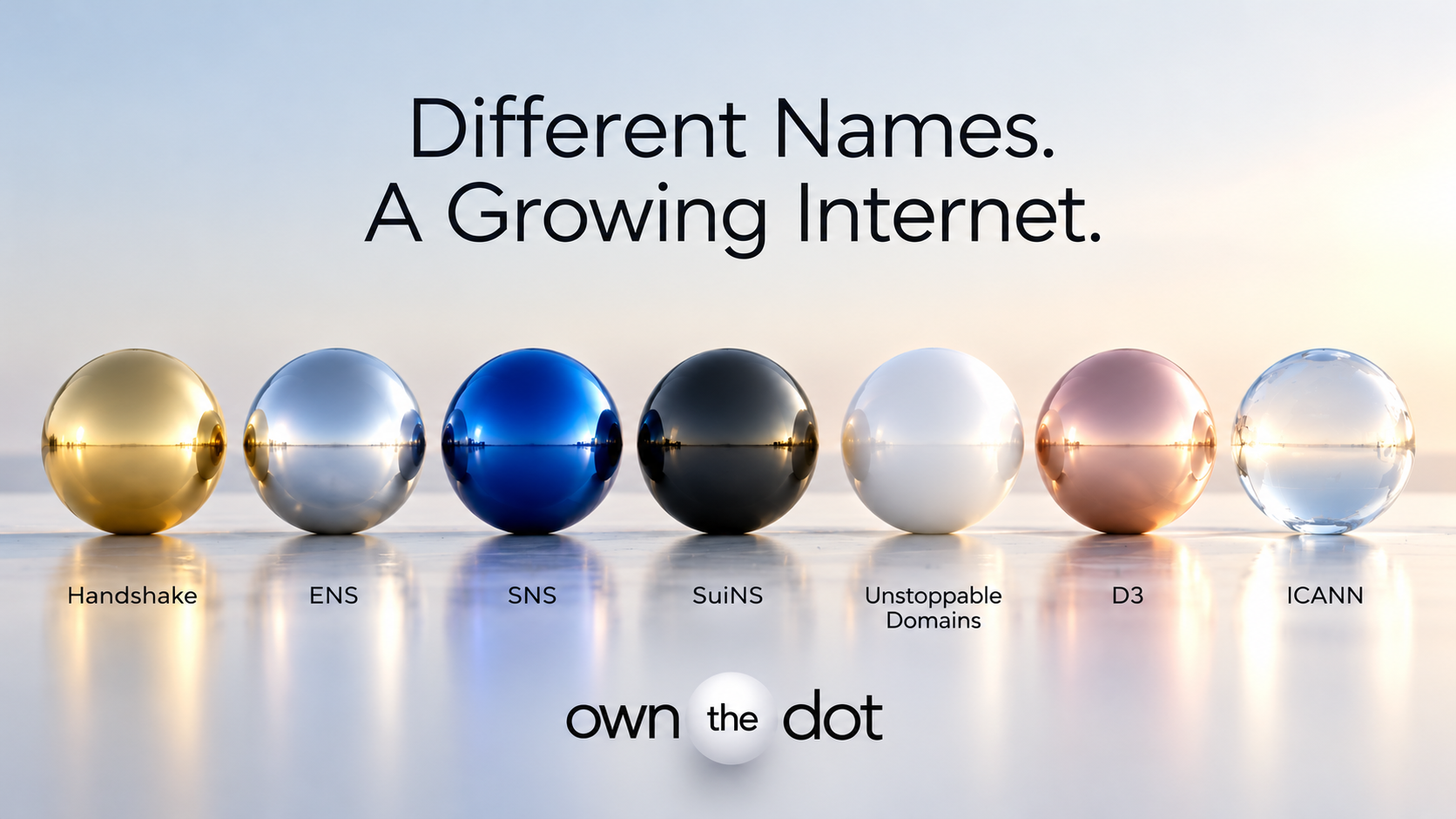
Different naming systems. Different rules. Different meanings of ownership.
For most of the internet's history, getting a domain name has meant choosing something to the left of an existing extension: yourname.com, yourbusiness.au or yourbrand.org.
Someone else operates the extension. You register a name beneath it, agree to the rules and pay to keep it.
Now there are more ways to name ourselves online. Some services make long wallet addresses easier to remember. Others connect blockchain identities to applications. Some aim to bring traditional domains onto blockchains. Handshake offers another choice: control of a top level name itself.
They all talk about ownership. But are they offering the same thing?
Ethereum Name Service (ENS)
ENS helps turn difficult Ethereum addresses into readable names such as yourname.eth. Those names can be used for payments, identity and other compatible applications.
ENS operates through smart contracts and community governance, including the ENS DAO. Registrations of ordinary .eth names have expiry dates and renewal requirements.
ENS also supports more sophisticated namespaces and connections with DNS. It's worth recognising that someone who controls a name beneath .eth doesn't automatically control the .eth extension itself.
Handshake (HNS)
Handshake starts in a different place. It allows people to register and control top-level names.
Someone who controls groen/, for example, can arrange names such as family.groen and mail.groen without buying each one from an outside registry. The holder manages the namespace.
Ownership and transfers are recorded on Handshake's blockchain. Names need to be renewed every two years by paying a network transaction fee, rather than a conventional annual registry charge.
Handshake has limitations. Its names don't work everywhere through ordinary browser and ISP settings. People generally need compatible resolvers or software, and a blockchain record doesn't remove the possibility of legal disputes or conflicting names in another system.
Still, its central idea is different: control over a top level namespace, not simply a name beneath someone else's extension.
Solana Name Service (SNS)
Solana Name Service makes blockchain addresses more readable within the Solana ecosystem.
It's also a useful example of how the rules and technology surrounding a name can change. In 2026, SNS began moving existing .sol names to .sns, while preparing a new .sol registry using different infrastructure.
According to the service's migration FAQ, existing names retain their ownership records and settings as .sns. Eligible holders are due matching names in the new .sol system, but the new names have a separate activation timetable. SNS says the old .sol resolution is paused during the transition and advises users to use .sns for supported payments until the new system is activated.
That doesn't mean holders have simply lost their names. It does show how a naming provider's technical decisions can affect what people see, what works and which suffix they use.
Sui Name Service (SuiNS)
SuiNS offers human readable identities within the Sui blockchain ecosystem. A name such as yourname.sui can help people send assets and identify themselves across compatible applications.
Names are registered for a period rather than forever. Sui's official documentation explains the renewal process and expiry rules.
For most users, a recognisable wallet name may be all they need. But registering beneath .sui isn't the same as owning or governing the .sui namespace.
Unstoppable Domains
Unstoppable Domains provides a range of digital naming products, including blockchain based names associated with extensions such as .crypto and .wallet.
Some of its Web3 names have been sold as one time purchases without renewal fees. The company also offers conventional DNS domains, where registration and renewal rules are different.
Two products sold by one company may have completely different ownership arrangements.
And as we've discussed in ICANN's New Dots, Someone Else's Problem?, a name on one blockchain doesn't necessarily prevent another naming system from using the same extension.
D3 and Doma
D3 is approaching naming from another direction. Through its Doma Protocol, it aims to bring traditional DNS domains into blockchain based transactions and applications.
That could help people trade and use domains in new ways while keeping a connection with established DNS infrastructure.
But representing a traditional domain on a blockchain doesn't automatically erase the underlying registry's conditions. Renewal requirements, contractual rights and applicable rules still matter.
A token representing a domain isn't necessarily the same thing as controlling the namespace in which that domain exists.
And What About Traditional DNS?
We shouldn't leave out the system most people already use.
The conventional Domain Name System connects familiar names with internet services and works across mainstream browsers and devices. Registries and registrars operate within established technical and contractual structures.
That broad compatibility is a considerable strength. But a conventional registration generally gives the registrant rights to use a name for a specified period, subject to the relevant rules. It doesn't normally give them control over the extension on the right of the dot.
What Are We Really Owning?
Every system here solves a different problem. Some make digital addresses easier to use. Others create identities across blockchain applications. Some connect existing domains with new technology. Handshake allows people to manage top level names directly.
None is free of limitations or dependencies.
Before registering, it's worth asking a few practical questions:
- Who controls the namespace and who can change its rules?
- Do I need to renew my name, and on what terms?
- Can I transfer it without asking a company for permission?
- Will it work in ordinary browsers and the services I use?
- What happens if another naming system uses the same name?
I don't think everyone needs to own a top level name. But those who want more control should have that choice, and everyone should understand the difference between holding a registered name and controlling the space around it.
Not all dots are created equal. Not all ownership means the same thing.
Own the Name | Own the Rules | Own The Dot