ICANN has revealed 1,615 applications for new generic top level domains (gTLDs) in its 2026 round.
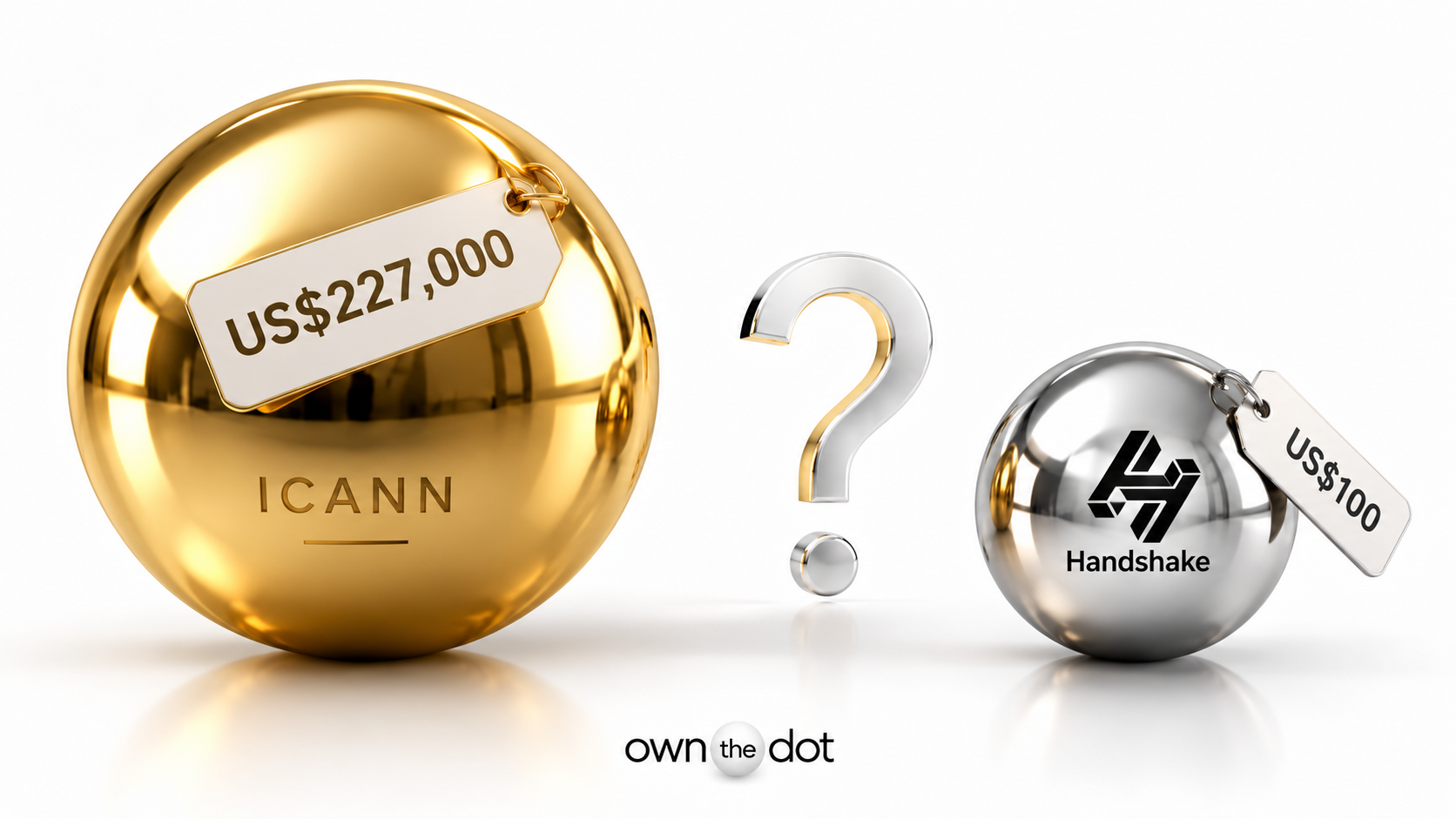
The standard application evaluation fee? US$227,000.
Listening to Todd Ryan's Domain Name Law Show yesterday got me thinking.
How many companies are willing to spend that much money pursuing just one domain extension?
And that's only the beginning.
US$227,000 Just to Apply
The application fee doesn't guarantee approval, let alone ownership of the desired extension.
When multiple companies apply for the same string, they may face additional costs resolving the competition, potentially through an auction.
Then there are the ongoing expenses.
Registry fees, technical infrastructure, compliance requirements and the responsibility of operating a namespace according to ICANN's rules.
The fixed registry fee alone is US$25,000 annually under the standard registry agreement, before applicable transaction fees and other operational expenses.
For some companies, that investment may make perfect business sense.
But for others, I wonder whether the money could be better spent elsewhere.
Why Not Buy an Established .com?
For that kind of money, wouldn't purchasing a premium, single-word .com be worth considering?
Not every premium .com will be available within that budget, of course. Some sell for considerably more.
But a well chosen .com comes with something a newly introduced extension doesn't necessarily have.
Recognition.
People understand .com. It's familiar, established and carries considerable weight across the internet.
A premium .com can also be developed into a recognisable business identity without the responsibilities of operating an entire registry.
A new gTLD might offer exclusivity, but will people recognise it?
Will businesses adopt it?
Or will it simply get lost in an expanding sea of domain extensions?
Having the ability to operate an extension is one thing.
Building demand for it is another.
What About Handshake?
Handshake already offers an alternative way to acquire top level names, often at a fraction of the cost of applying through ICANN.
There is no US$227,000 application fee.
Names are obtained through blockchain auctions or secondary markets, with ownership controlled through cryptographic keys and maintained through periodic renewals.
there are differences.
Handshake names aren't universally accessible through conventional DNS resolution today. ICANN approved extensions have the advantage of established global infrastructure and compatibility.
But will that distinction always matter as much as it does today?
When AI Agents Start Finding Us
As AI agents become more capable of searching, navigating and interacting across different online environments, the way we discover websites and services may begin to change.
Today, most people rely on browsers, search engines and familiar domain extensions.
Tomorrow, an AI agent might locate a business, service or individual across several different naming systems without requiring the user to understand how those systems work.
That doesn't mean technical compatibility issues will simply disappear. Resolution, security and trust will still matter.
But what if agents eventually make those differences largely invisible to everyday users?
An ICANN extension, a Handshake name or another naming system could become alternative ways of reaching the same destination.
And if that happens, Handshake's considerably lower cost of entry could become a meaningful advantage.
Especially for individuals, developers and smaller businesses that could never justify spending hundreds of thousands of dollars on a name.
So What's a Name Really Worth?
I'm not suggesting that US$227,000 is unreasonable for everyone.
For a global corporation wanting its own branded namespace, or a registry operator with a viable business model, the investment could be justified.
But the internet is changing.
And perhaps the value of a name will increasingly depend less on which naming system it belongs to and more on whether people, browsers and AI agents can find it.
If those technological barriers continue to come down, the economics of digital naming could look very different.
What happens to the perceived value of a US$227,000 domain extension when an AI agent can find a US$100 Handshake name just as easily?
The US$100 is an illustrative acquisition price, not a fixed cost or a claim that both names offer identical capabilities.
But the question remains.
It’s one that makes Handshake interesting to watch.
Further listening: Todd Ryan — Domain Name Law Show (X)
Own The Name | Own The Rules | Own The Dot.