The internet was built to connect people, share information and communicate freely across borders. For many of us, that freedom has become such an ordinary part of everyday life that we rarely stop to consider how easily it could be restricted.
Recent developments in France offer a reminder.
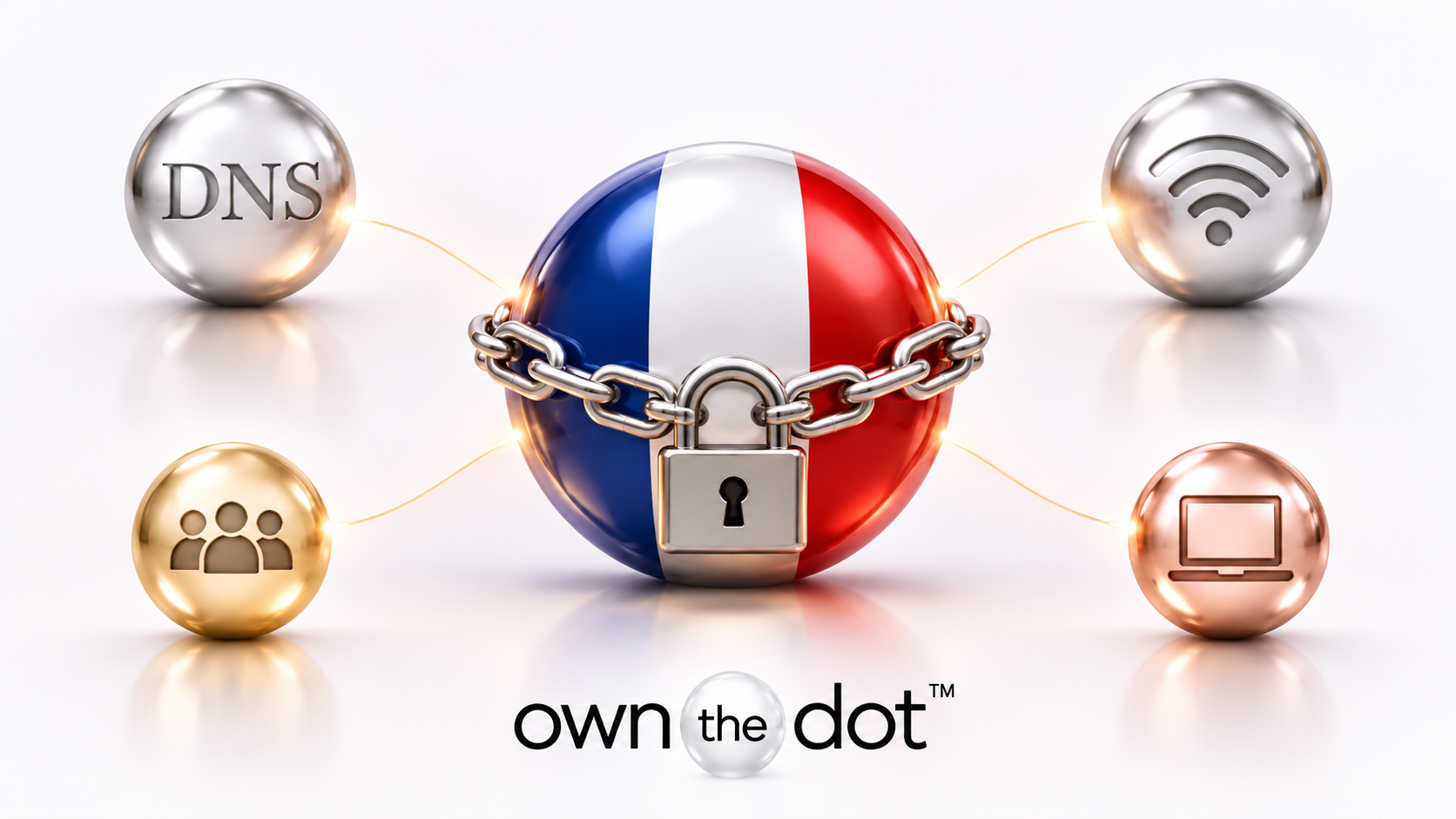
French authorities reportedly considered measures that would allow access to major social media platforms to be restricted during periods of public unrest. Although the proposed restrictions were not implemented, the possibility of using internet infrastructure to limit public communication has raised concerns among digital rights advocates.
At the centre of this discussion is something most internet users rarely think about: the Domain Name System, or DNS.
The DNS is what helps us reach websites using familiar names rather than complicated numerical addresses. Every time we visit a website, check an online service or access information through a domain name, we depend on this system working as intended.
Yet the same infrastructure that helps us find information can also be used to prevent us from reaching it.
By requiring internet service providers to interfere with DNS resolution, authorities can make websites and online services inaccessible to people using those networks. The content itself may still exist, and the website may continue operating elsewhere, but for those affected, the destination can become unreachable through their usual internet connection.
That is a considerable amount of power to exercise over something as fundamental as internet access.
Governments have legitimate responsibilities when it comes to public safety. Nobody should dismiss the harm that can arise when online platforms are used to organise violence, threaten individuals or facilitate criminal activity.
However, restricting access to an entire platform is quite different from addressing specific unlawful behaviour.
Social media has become an important means of communication for businesses, journalists, families and communities. During public demonstrations, it can also provide a way for individuals to document events, share information and communicate with others.
Blocking access to these services does not distinguish between someone engaging in unlawful activity and someone simply exercising their right to communicate.
It potentially affects everyone.
There is also the question of how effective such restrictions would actually be.
People familiar with alternative DNS resolvers or virtual private networks may find ways around certain forms of blocking. Meanwhile, ordinary internet users who rely on their provider's default settings may simply lose access.
The result could be a system where those with technical knowledge retain access while everyone else is left with whatever their internet provider has been instructed to permit.
I find that particularly troubling.
The internet was never intended to become a place where access to information depends on whether someone has the technical ability to work around restrictions imposed on them.
This is one of the reasons I believe greater awareness of independent internet naming systems is important.
Handshake, for example, provides an alternative naming protocol that operates independently of the conventional DNS root coordinated through ICANN.
Rather than relying on a centrally administered root registry, Handshake uses a decentralised blockchain to record and manage top level names.
It demonstrates that internet naming can exist beyond a single administrative structure, allowing people to establish and maintain names through a different system.
That independence does not mean Handshake can prevent every form of censorship. Governments and internet service providers can still restrict network connections, block IP addresses or interfere with access in other ways. Handshake also requires compatible software and infrastructure to be accessible.
Nevertheless, having independent naming systems offers something valuable: choice.
It reduces the assumption that there must be only one authority, one approach or one structure through which the internet's naming system operates.
And as our dependence on the internet continues to grow, I believe that choice becomes increasingly important.
France's proposal also reflects a wider development occurring internationally. Governments are becoming more involved in deciding how online services should operate, what content should be restricted and what responsibilities should be placed on the companies providing those services.
Some of these measures are understandable, particularly where there are genuine concerns about safety and unlawful activity.
But there is a difference between protecting people from harm and giving authorities broad powers that may also restrict lawful expression.
A measure introduced with the intention of protecting public safety today could potentially be used under very different circumstances tomorrow.
That possibility deserves careful consideration before such powers become an accepted part of internet governance.
We should also remember that the internet is not simply a collection of websites and platforms. It has become essential infrastructure supporting banking, education, healthcare, commerce and communication.
The systems that allow us to reach those services should be reliable, resilient and as independent as reasonably possible.
This is why I continue to support the development and recognition of alternative naming technologies, including Handshake.
Not because the conventional DNS should disappear, or because governments should have no role in addressing unlawful online behaviour, but because the internet benefits from having alternatives.
France's proposed restrictions were not implemented, and that distinction matters. However, the fact that they were reportedly considered should encourage a broader discussion about how much control governments ought to exercise over the infrastructure we increasingly depend upon.
The internet has given ordinary people an extraordinary ability to communicate, share ideas and reach information without needing permission from those in authority.
I would like to see that freedom preserved.
Because an internet that connects everyone should not become an internet where access depends on who decides we are allowed to connect.
Own the Name. Own the Rules. Own The Dot.
The views expressed in this article are those of Erwin Groen and do not necessarily represent the position of Handshake Australia.
Source: CircleID — France's Proposed DNS Blocks Draw Criticism Over Internet Access and Free Expression