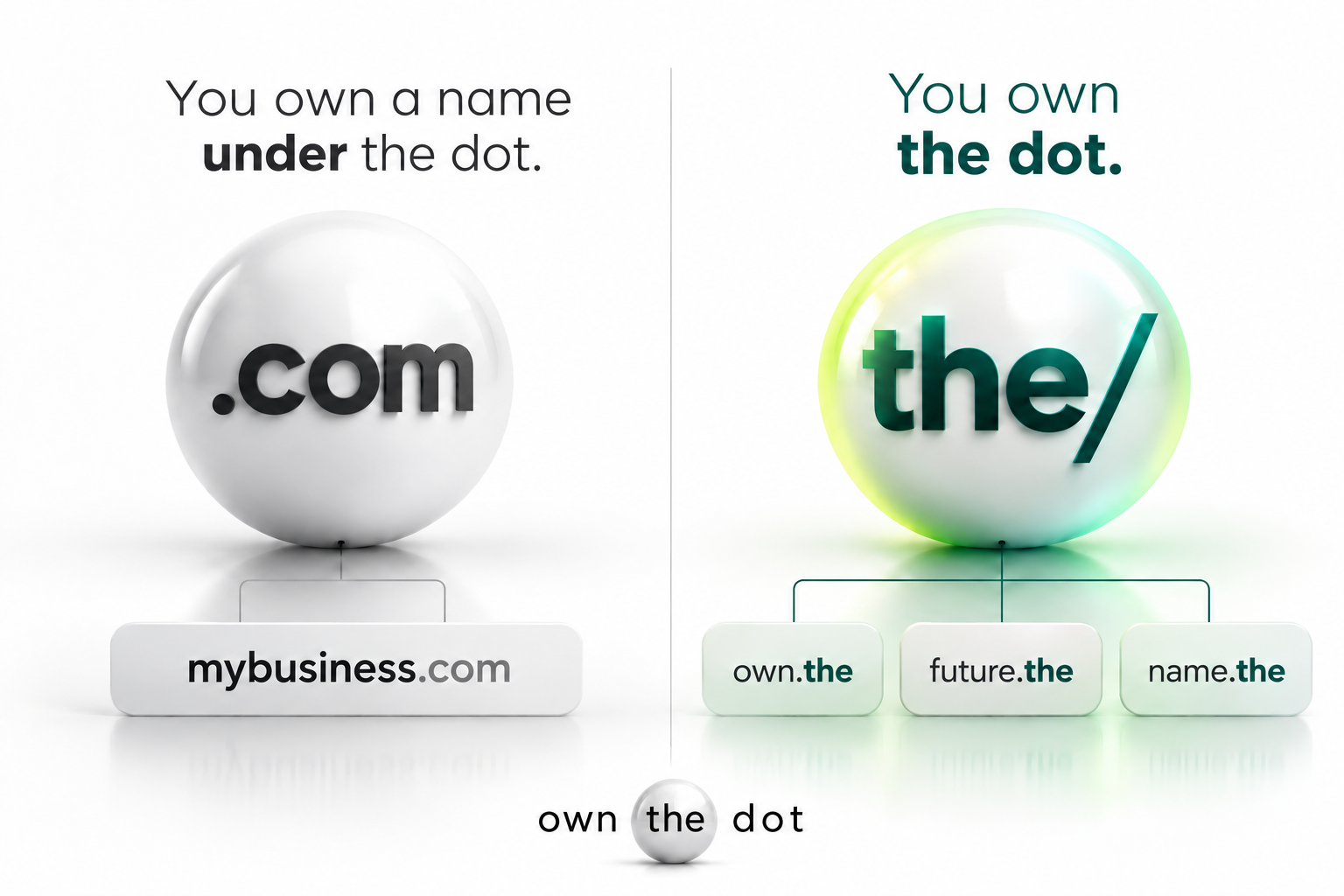
Most people who buy a domain name are actually buying a name under someone else’s extension.
For example:
mybusiness.com
You own mybusiness.com.
But.. you do not own .com.
The same applies to names ending in .net, .org, .wine and many others.
You own the name underneath the dot.
Web3 Started to Change This
Blockchain naming introduced a different idea.
Instead of simply renting or registering a name through the traditional domain system, some blockchain naming systems allow you to hold the name yourself.
Some even allow people to ‘own’ something that looks like their own extension.
Do you own a name under the dot, or do you own the dot itself?
Handshake Works Differently
Handshake is built around top level names.
So if you own:
the/
you are not owning a name underneath another Handshake extension.
the/ is the top level name.
You can then create names underneath it, such as:
own.the
future.the
name.the
In simple terms, you own the part at the top and you decide what can sit underneath it.
Why Is That Different?
Other blockchain naming platforms can also offer TLD like names.
But those names usually exist inside that platform’s own system.
Handshake takes a different approach because its blockchain is used to manage the root level names themselves.
So the important question is not just:
“Is this a blockchain domain?”
It is:
“Where does the dot live?”
Why Could This Matter?
As the internet grows, we may start seeing many more extensions.
Most people may not know which naming system sits behind them.
They may simply click a link, type a name, or ask an AI assistant to find something for them.
That could make the technology behind the name almost invisible.
But ownership still matters.
There is a big difference between:
owning a name under someone else’s dot
and
owning the dot itself.
Own The Name | Own The Rules | Own The Dot.